Blog ·
ACT September 19, SAT October 3: Give the Phone Three Jobs
ACT is September 19 and the next SAT is October 3. Separate the phone's night-before, test-morning, and after-test jobs.
On this page8 sections
At 8 p.m. on Friday, “leave the phone open until the ACT is over” sounds like one decision. It isn't. The phone has a job tonight, a different job at the test center, and a third job when the student comes home.
That split matters on Friday, September 18, 2026. The next national ACT is tomorrow, September 19. The next SAT Weekend date is October 3 at 7:45 a.m. local time, and standard registration for it closes tonight at 11:59 p.m. ET; late registration runs through September 22. The fall in-school testing window, which includes the PSAT/NMSQT, runs from October 1 through October 30.
Those dates call for a small plan, not a weekend-wide unlock.
Tomorrow morning and tonight are different jobs
ACT's test-day instructions tell students to keep phones, smartwatches, fitness bands, and other Wi-Fi or recording devices off and out of sight. The rule continues through breaks. If a student accesses or activates a device, ACT says the student will be dismissed, the test won't be scored, and the device may be confiscated. ACT's separate calculator policy also rules out calculators built into phones or electronic communication devices.
College Board's prohibited-device policy covers the same vulnerable moment. Unless a student has an approved accommodation, phones, smartwatches, fitness trackers, smart glasses, and other wearable technology cannot be accessed during the SAT or its breaks. A noisy device—or a student seen with one—may lead to dismissal, score cancellation, and confiscation. Test staff may collect phones, require backpack storage away from the desk, or deny admission.
These are test-center rules. They answer what happens to the phone on Saturday morning; they don't decide which homework tools should remain available on Friday night. For that, the family still has to name the portal, calculator, or practice app the student will actually use. Our guide to choosing always-on homework tools is useful when “school apps” is still too vague.
Write three rows, not one big unlock
The evening plan can fit on three rows. The timing changes by exam, but the jobs do not.
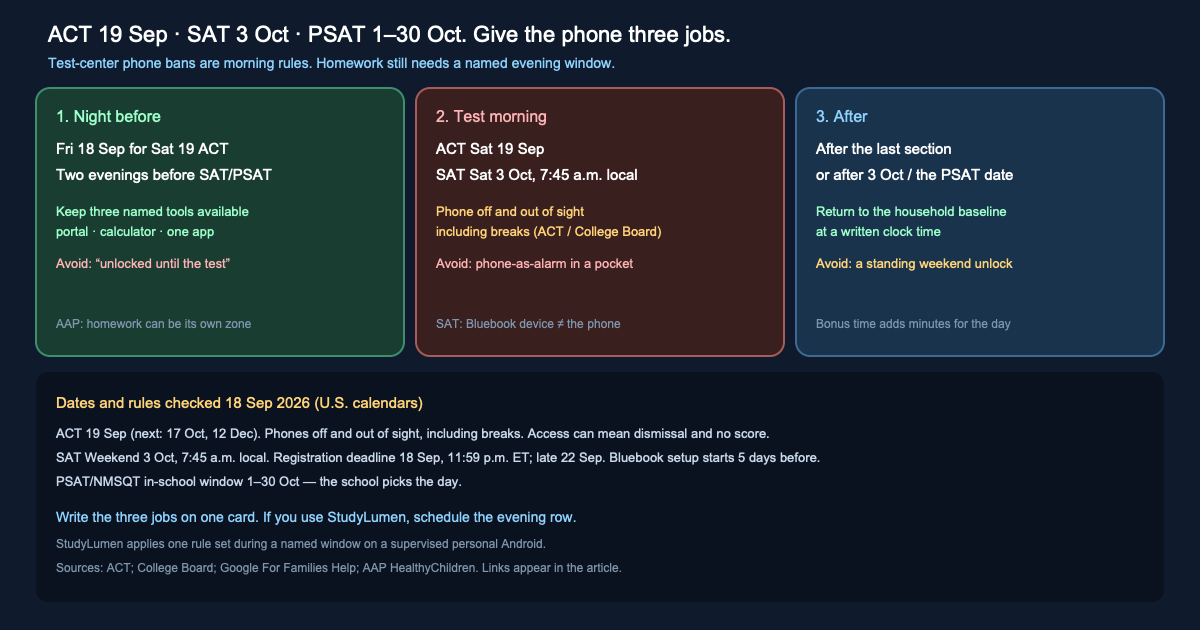
Three phone jobs around an ACT, SAT, or PSAT date
- Job
- Night before
- When
- September 18 for the September 19 ACT; the two evenings before the household's SAT or PSAT date
- What the phone does
- Keep named study tools available and pause feeds, games, and short video
- Common mistake
- “Unlocked until the test”
- Job
- Test morning
- When
- September 19 ACT; October 3 SAT; the school's October PSAT day
- What the phone does
- Off and out of sight under the test provider's rules
- Common mistake
- Using the phone as an alarm, then leaving it in a pocket
- Job
- After
- When
- At a written clock time after the final section
- What the phone does
- Return to the normal household rule
- Common mistake
- Letting a one-day exception become a standing weekend unlock
| Job | When | What the phone does | Common mistake |
|---|---|---|---|
| Night before | September 18 for the September 19 ACT; the two evenings before the household's SAT or PSAT date | Keep named study tools available and pause feeds, games, and short video | “Unlocked until the test” |
| Test morning | September 19 ACT; October 3 SAT; the school's October PSAT day | Off and out of sight under the test provider's rules | Using the phone as an alarm, then leaving it in a pocket |
| After | At a written clock time after the final section | Return to the normal household rule | Letting a one-day exception become a standing weekend unlock |
Two students sitting different exams need two cards. One child's Saturday ACT does not erase the other child's Sunday homework window. If the week is already crowded, a Sunday reset can put both dates on the same household calendar without merging their rules.
The American Academy of Pediatrics offers homework as one example of a screen-free zone in its family media-plan guidance. It also recommends revisiting the plan at the beginning of a school year. That guidance establishes a useful planning habit; the exact apps and end time still belong to the household.
For the SAT, the test device is not the phone
Digital SAT preparation adds a second screen, which makes a blanket “devices off” rule unhelpful the night before.
College Board's test-day checklist calls for a fully charged testing device with Bluebook installed and exam setup completed. Exam setup becomes available five days before the test and produces the admission ticket. College Board prefers a printed ticket, and the required photo ID must be a physical document rather than an image on a phone.
Treat the laptop or tablet as test equipment. If practice happens there, the phone can still follow a short pause list. If the only practice tool is a phone app, name that app instead of opening every website and social feed. Students who need to borrow a College Board device must request it at least 30 days before test day, so that option is no longer available to someone first planning for October 3 today.
A PSAT date belongs to the school
College Board lists October 1–30, 2026 as the fall in-school testing window. That is a window, not one national Saturday. The school or district handles the administration and tells students which day applies.
Once that date is known, use the same three rows: a named evening window, the school's test-day phone rule, and a return to baseline after dismissal. A month-long lock for “PSAT month” solves a different problem than the one on the calendar.
Bonus time is useful when practice runs long
Google describes Family Link Bonus time as extra device time for the day. It does not change the daily limit, Downtime, or School time schedule. That makes it a good fit when a practice test overruns by 20 minutes.
It does not rewrite which apps remain available. Google's schedule guide says families can choose whether unlimited-time apps work during Downtime and School time, so check that list before copying a school-day setup into the evening. The homework check for Family Link School time walks through that exact decision.
Need one missing app or site? A request with a named target and a clear end time is easier to review than a silent full-device unlock. See temporary access requests versus silent unlocks for the tradeoff.
Put the plan on one card
The card is intentionally ordinary. Paper works. A shared note works. What matters is that another adult can read it and reach the same decision.
A seven-line exam phone-plan card
- Line
- Date and exam
- Write this down
- ACT September 19; SAT October 3; or the school's PSAT date
- Line
- Study window
- Write this down
- A start time and an end time
- Line
- Keep available
- Write this down
- Three names: portal, calculator, and one practice tool
- Line
- Pause
- Write this down
- Feeds, games, and short video used on this device
- Line
- Extra-time rule
- Write this down
- One app or site, a number of minutes, then back to the study rule
- Line
- Test morning
- Write this down
- Phone off and out of sight; for the SAT, charge the Bluebook device and bring the physical ID
- Line
- Return to baseline
- Write this down
- A clock time after the exam, not “whenever it is over”
| Line | Write this down |
|---|---|
| Date and exam | ACT September 19; SAT October 3; or the school's PSAT date |
| Study window | A start time and an end time |
| Keep available | Three names: portal, calculator, and one practice tool |
| Pause | Feeds, games, and short video used on this device |
| Extra-time rule | One app or site, a number of minutes, then back to the study rule |
| Test morning | Phone off and out of sight; for the SAT, charge the Bluebook device and bring the physical ID |
| Return to baseline | A clock time after the exam, not “whenever it is over” |
The same card works for later national ACT dates on October 17 and December 12, and for SAT Weekend dates on November 7 and December 5. Recheck the provider's calendar before reusing it; the job names can stay while the dates change.
If you want the card to run automatically
On a supervised personal Android, StudyLumen can put the evening row on a schedule. One routine activates one rule set for that window; website filtering can remain off when the household does not need it. If a supervisor approves temporary access until 5:15, the recorded grant end time closes that access at 5:15.
That is the narrow fit here: carrying a written evening decision onto the device. StudyLumen does not run the ACT, SAT, or PSAT test center, and it does not replace Family Link's account controls. The StudyLumen and Family Link comparison explains where the two tools overlap and where they do not.
Sources
- ACT Exam Test Dates and Deadlines, ACT, accessed September 18, 2026.
- ACT Test Day Checklist, ACT, accessed September 18, 2026.
- ACT Calculator Policy, ACT, accessed September 18, 2026.
- SAT Suite Test Dates and Deadlines, College Board, accessed September 18, 2026.
- October 3, 2026 SAT Test Date, College Board, accessed September 18, 2026.
- What to Bring on Digital SAT Test Day, College Board, accessed September 18, 2026.
- Prohibited Devices, College Board, accessed September 18, 2026.
- Score Release Dates for Students and Educators, College Board, accessed September 18, 2026.
- Manage Your Child's Screen Time, Google For Families Help, accessed September 18, 2026.
- Set a Schedule on Your Child's Device, Google For Families Help, accessed September 18, 2026.
- How to Make a Family Media Plan, American Academy of Pediatrics, updated January 20, 2026; accessed September 18, 2026.