Blog ·
50 Minutes After 10 p.m. Were Not a Homework Window
A 2026 Android study logged school-night phone use after 10 p.m. Its 50-minute mean is a reason to name when homework ends, not a universal bedtime.
On this page6 sections
The assignment says Turned in. The portal is closed. The phone stays beside the pillow anyway, because there might be one more school message.
That “just in case” hour is easy to call homework after the fact. A 2026 research letter in JAMA Pediatrics offers a cleaner label: smartphone use during a defined school-night window. It measured what was in the foreground on Android phones. It did not record homework.
The researchers watched one overnight Android window
Jason Nagata and colleagues used passive logs from the Effortless Assessment Research System app in a subsample of the U.S. Adolescent Brain Cognitive Development Study. The analysis included 657 adolescents, with a mean age of 15.29 years, who had at least two eligible weekdays between September 2022 and May 2024. Federal and school holidays were excluded.
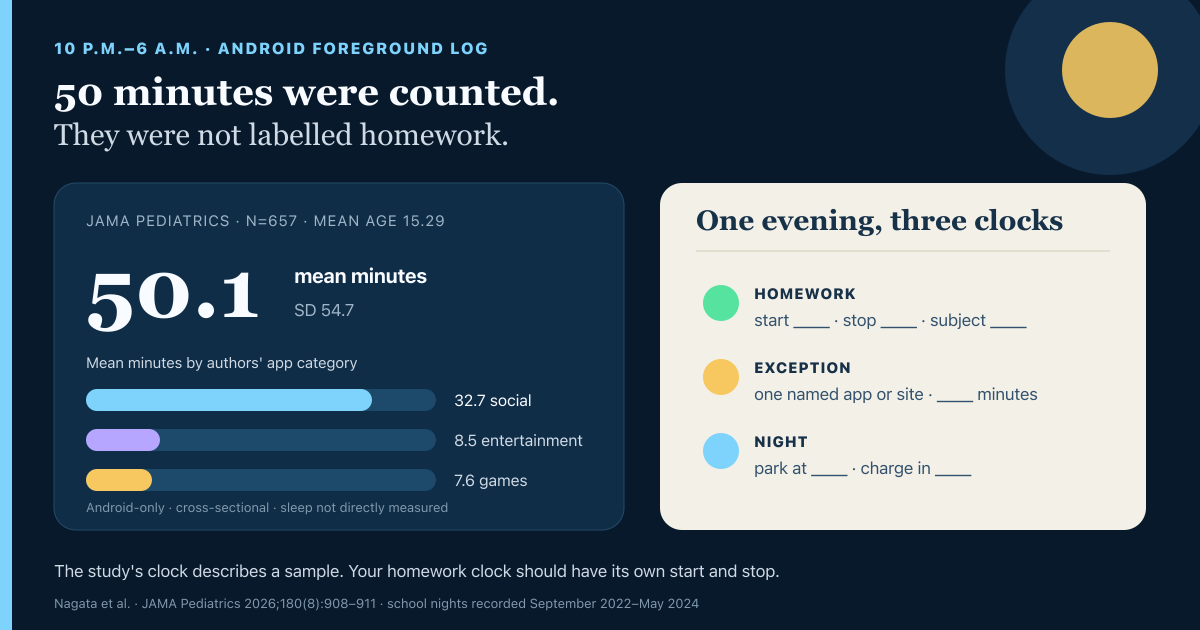
The researchers chose 10 p.m. to 6 a.m. on Sunday through Thursday nights. Across the recorded nights, mean foreground smartphone use was 50.1 minutes, with a standard deviation of 54.7 minutes. 164 participants averaged at least 71.8 minutes.
That spread is as important as the mean. “Fifty minutes” does not describe every teenager or every night. It is not a bedtime instruction, either.
The study's boundaries travel with the number: the sample was Android-only, the app logged short collection windows, the analysis was cross-sectional, and sleep was not directly measured. The data cannot tell us which came first or whether phone use caused a sleep outcome. The researchers also did not label minutes as homework.
Most logged time sat in the social-media bucket
The authors grouped foreground apps by category. In the same 10 p.m.–6 a.m. window, the means were:
- Authors' category
- Social media
- Mean minutes
- 32.7
- Examples in the paper
- YouTube, Instagram, TikTok
- Authors' category
- Entertainment
- Mean minutes
- 8.5
- Examples in the paper
- Netflix, Disney+
- Authors' category
- Games
- Mean minutes
- 7.6
- Examples in the paper
- Roblox, Clash Royale
| Authors' category | Mean minutes | Examples in the paper |
|---|---|---|
| Social media | 32.7 | YouTube, Instagram, TikTok |
| Entertainment | 8.5 | Netflix, Disney+ |
| Games | 7.6 | Roblox, Clash Royale |
More than 65% of the logged time fell in the social-media category. The grouping matters for YouTube in particular. A teacher-assigned documentary and the next recommended short can occupy the same app; the log sees the app, not the purpose.
The paper also reports that 342 adolescents, or 52.1%, used a phone between midnight and 4 a.m. at least once during the study period. “At least once” is not “every night.” Their mean in that shorter slice was 23.7 minutes.
These figures describe an overnight pattern in this sample. They do not turn the phone into a medical instrument, and they do not set an acceptable number of minutes for another household.
A Daily Limit cannot tell research from the feed
Family Link can count time on a child's Android device or Chromebook, but the Daily Limit does not know why an app is open. Bonus time adds minutes for that day without rewriting Downtime or School time. Apps marked Unlimited skip the Daily Limit and may remain available during those schedules.
That last detail is where a broad exception can swallow the plan. Marking YouTube Unlimited because one class sometimes uses it also leaves the recommendation feed outside the Daily Limit. Allowing Chrome because the portal lives in one tab can bring every other site with it. The app-versus-browser guide explains why those are separate decisions.
School time is not a ready-made evening mode. Google says it silences call and text notifications while calls and texts remain possible, and its available apps come from the Unlimited list. The School time checklist can help if that list has quietly become the household's homework plan.
Give the evening three separate clocks
The study used one clock for analysis. A household needs three because the phone changes jobs.
- Clock
- Homework
- Write down
- Start ____ · stop ____ · subject ____
- What ends it
- The planned stop time or submitted assignment
- Clock
- Exception
- Write down
- One app or site ____ · for ____ minutes
- What ends it
- The named timer, not a promise to remember later
- Clock
- Night
- Write down
- Device parks at ____ · charging place ____
- What ends it
- The next morning
| Clock | Write down | What ends it |
|---|---|---|
| Homework | Start ____ · stop ____ · subject ____ | The planned stop time or submitted assignment |
| Exception | One app or site ____ · for ____ minutes | The named timer, not a promise to remember later |
| Night | Device parks at ____ · charging place ____ | The next morning |
Now add the tool list beneath the homework clock: class app, calculator, and the one page the teacher named. Feeds, games and stores wait. If the assignment is on paper, the phone may have no academic job at all.
The night clock should begin when the homework clock ends, not at an arbitrary research threshold. A child who finishes at 8:15 and one who returns from practice at 9:30 need different plans. The important part is that “homework” stops being an indefinite reason to keep the whole device open.
Review what happened after a week. The five-question routine review is more informative than asking whether the household hit a single total.
When the homework clock needs to repeat
StudyLumen can turn that first clock into a recurring routine on a supervised personal Android. One routine activates one rule set: named school tools stay available while selected apps pause, with optional website filtering when a browser genuinely belongs in the assignment.
An unexpected link can be handled as a request for one app, site or extra-time target. The approved grant ends at its recorded time, so the exception does not silently become the night clock. StudyLumen does not measure sleep or interpret the ABCD logs; it applies the household's written study boundary. The Family Link comparison shows how the two controls can sit beside each other.
Sources
- Nagata JM, Koffkey C, Baker FC, Hale L, Late-Night Smartphone Use Among US Adolescents, JAMA Pediatrics 2026;180(8):908–911, published 1 August 2026.
- U.S. National Library of Medicine, PubMed record 42149585, retrieved 23 September 2026.
- Google For Families Help, Manage screen time, retrieved 23 September 2026.
- Google For Families Help, Set app time limits, retrieved 23 September 2026.
- Google For Families Help, Set a schedule, retrieved 23 September 2026.