Blog ·
The Phone Comes Back at Dismissal. Who Owns the Homework Window Before Pickup?
NYC school-day rules, national afterschool survey data, and a six-line handoff card for the 3–6 p.m. homework window.
On this page7 sections
At 3:18, a child's personal phone is back in their hand, the school Chromebook is in a backpack, and the adult handling dinner may still be at work. Homework has not waited for the family calendar to clear. It may begin at a program table, on a late bus, at a grandparent's house, or in an empty kitchen.
That stretch of the day needs a handoff, not another slogan about screen time. The useful questions are ordinary ones: Who is there? Which device does the assignment need? When does the homework block end? What happens if unfinished work moves to the evening?
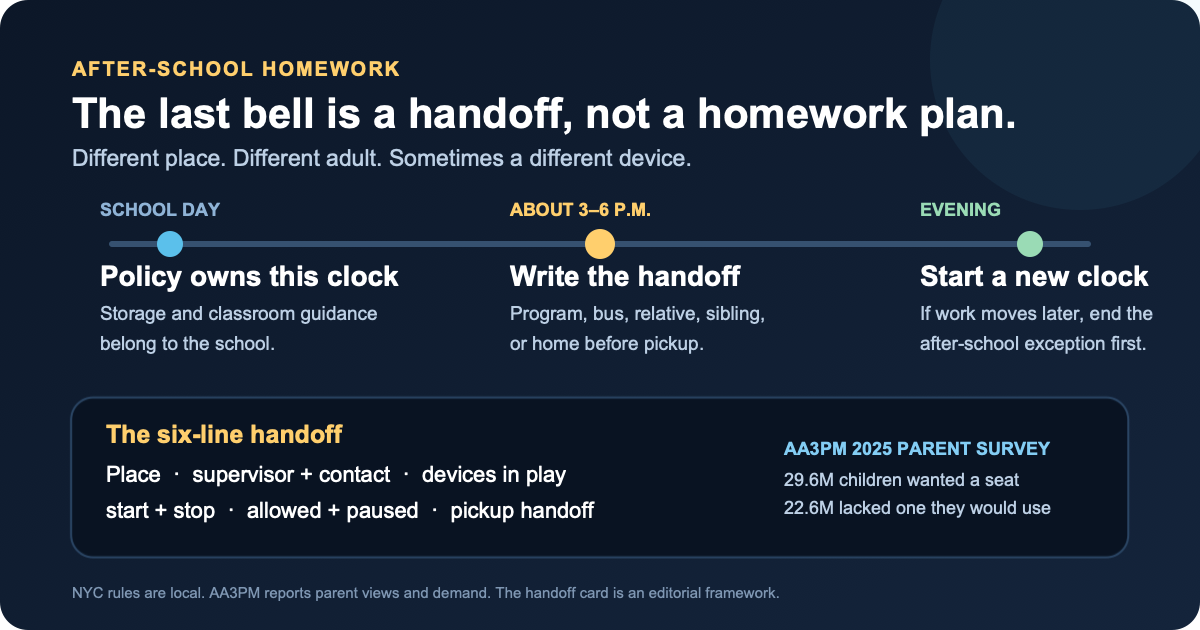
At dismissal, two devices may trade places
New York City Public Schools' 2026–27 guidance recommends no individual screen use in 2-K through grade 2, no more than 30 minutes a day in grades 3–5, and no more than 45 minutes in grades 6–8. Those are classroom recommendations for New York City, with stated exceptions. They are neither a national health limit nor a homework allowance.
NYC's personal-device policy deals with another screen. Personal internet-enabled devices are stored during the school day, while school-issued devices remain available for their intended use. Schools restore access to the personal device at the end of the day. A child can therefore leave with both a returned phone and schoolwork that still requires a screen.
The city's guidance also says afterschool providers will receive policy-aligned guidance. That matters: after-school is not automatically a rule-free zone. It still does not write a household's clock for the bus, a relative's home, or the hours before pickup.
One district shows how local the boundary can be. Savannah-Chatham County Public School System's 2026–27 FAQ says its cellphone policy does not apply to after-school activities or events, although it recommends keeping devices locked during academic tutoring. That is one Georgia district, not a national pattern. It is a reason to ask the actual program what happens after the bell.
The adult changes before the homework does
The person who set the family rule may not be the person in the room when it matters. Between 3 and 6 p.m., enforcement can pass from a teacher to a program leader, bus driver, grandparent, older sibling, or no adult at all.
Three device-rule clocks across a school day
- Part of the day
- School day
- What is known
- School policy, storage, and classroom guidance
- What still needs a decision
- Whether tonight's assignment needs a personal device
- Part of the day
- After school
- What is known
- Program rules and whoever is supervising
- What still needs a decision
- Start, stop, allowed tools, paused apps, and pickup handoff
- Part of the day
- Evening
- What is known
- The household's usual routine
- What still needs a decision
- Whether unfinished work gets a new, named window
| Part of the day | What is known | What still needs a decision |
|---|---|---|
| School day | School policy, storage, and classroom guidance | Whether tonight's assignment needs a personal device |
| After school | Program rules and whoever is supervising | Start, stop, allowed tools, paused apps, and pickup handoff |
| Evening | The household's usual routine | Whether unfinished work gets a new, named window |
Treating those as one long “screen-time” total hides the handoff. A school Chromebook may be essential for Classroom. A personal phone may be useful for a calculator or worksheet photo. Neither fact answers whether a short-video feed should stay open beside the assignment.
The national survey describes a care gap, not a homework cure
The fifth edition of America After 3PM surveyed 30,515 US parents and guardians of school-age children between January 31 and April 21, 2025. Parents wanted an afterschool program for about 29.6 million children; 22.6 million of those children were not enrolled even though a parent said they would enroll them if a program were available. That is 77% of the reported demand left unmet.
The report also found that 86% of parents agreed afterschool programs give children more time for fun and educational activities and less time on phones and other screens. Among parents whose child was enrolled, 72% were satisfied with the program's homework help. These are parent views, not device logs or test results. They do not show that a program reduces a particular child's phone use or improves grades. Cost was an important barrier for 56% of parents without a program, according to the report's executive summary.
The numbers explain why the 3–6 p.m. hours cannot be treated as a minor edge case. They do not supply the missing device rule. A seat in a program, a place on a bus, and time at a relative's house are different arrangements with different adults and equipment.
Pew looked at another population and another question. In a May 2025 survey of US parents of children 12 and younger, 86% said they had rules about when, where, or how screens could be used. Across the full sample, 19% said the rules held all the time and 55% most of the time (full report). A written handoff will not make every evening tidy, but it gives the next adult something more usable than “be sensible.”
Put the handoff on six lines
Write the card for the person who is actually there. Use real names and clock times; “until pickup” is slippery when pickup moves.
Six-line after-school homework handoff card
- Write down
- Place
- Example
- Library program, then grandmother's house
- Write down
- Supervisor and contact
- Example
- Ms. Lee until 5:15; Arun after that
- Write down
- Devices in play
- Example
- School Chromebook; personal Android stays in bag
- Write down
- Homework window
- Example
- 3:45–4:45
- Write down
- Allowed and paused
- Example
- Classroom, Docs, calculator; pause feeds, games, and extra browsers
- Write down
- Pickup handoff
- Example
- Note unfinished work; regular phone rule resumes at 4:45
| Write down | Example |
|---|---|
| Place | Library program, then grandmother's house |
| Supervisor and contact | Ms. Lee until 5:15; Arun after that |
| Devices in play | School Chromebook; personal Android stays in bag |
| Homework window | 3:45–4:45 |
| Allowed and paused | Classroom, Docs, calculator; pause feeds, games, and extra browsers |
| Pickup handoff | Note unfinished work; regular phone rule resumes at 4:45 |
If a classmate sends a missing PDF at 4:05, name the exception and its end instead of opening the whole phone until dinner. The group-project exception card shows how to keep that request narrow. If the assignment moves to the evening, start a new window; do not leave the after-school exception running in the background.
The American Academy of Pediatrics includes during homework among possible screen-free zones in a family media plan. In a device-dependent assignment, “screen-free” may need to mean free of unrelated screens and alerts rather than free of every screen. The card makes that distinction visible.
Family Link can hold a clock, but the family has to choose it
Google documents School time and Downtime as weekly schedules on supervised Android 7+ devices. Families can decide whether apps marked Unlimited remain available, and School time silences some notifications while calls and texts remain possible (Set a schedule).
The label “School time” does not turn it into the after-school card above. A family can set a separate schedule that matches the real homework block, or use another method. What matters is that 3:45–4:45 is chosen deliberately instead of inherited from the school day.
A Family Link daily limit answers a different question: how much device time is available today. Google says the limit applies to each Android device or Chromebook, so two hours means two hours on each device, not two hours shared across the household. Bonus time adds time for the day without rewriting the daily limit or the Downtime or School time schedule (Manage screen time). The broader Family Link study-routine guide covers that setup, and the always-available apps checklist helps separate required tools from recreation.
If the personal Android should follow the card
Paper may be enough. On a supervised personal Android, StudyLumen can instead turn the card into one scheduled routine and one rule set: the selected app and website boundaries apply only during the enabled window, and an approved temporary-access request ends at its recorded time. Temporary access requests are useful when the after-school adult needs one site rather than an open-ended unlock.
StudyLumen does not run a school's device-management system, control a program computer, read chats, supervise an iPhone, or promise grades. Its role here is smaller: make the household's after-school decision match the clock and the device that actually come through the door.
Sources
- Guidance on Artificial Intelligence and Screen Time — New York City Public Schools, 2026–27; classroom recommendations and afterschool note
- Cell Phone and Electronic Device Policy — New York City Public Schools; personal-device storage and return
- Lost Opportunity: Afterschool in Demand, But Out of Reach for Many — Afterschool Alliance / Edge Research, fifth America After 3PM report
- Lost Opportunity executive summary — Afterschool Alliance, October 2025
- How Parents Manage Screen Time for Kids — Pew Research Center, October 2025; US parents of children 12 and younger
- Set a schedule on your child's device — Google For Families Help
- Manage your child's screen time — Google For Families Help
- How to Make a Family Media Plan — American Academy of Pediatrics / HealthyChildren.org
- Updated Policy on Student Use of Electronic Devices for 2026–27 — Savannah-Chatham County Public School System; local after-school example